 news
news
Designing rare earths out of the electric motor
Our CEO, Jarek Rzepecki, spoke to Sabbir Rangwala for Forbes about the sovereign supply chain challenge for physical AI and our recent proof of concept with Hyundai CRADLE and Hyundai Motor Group’s R&D team on AI-driven EV motor design.
The magnet is the pinch point
One relatively consistent feature of the physical AI market is the need for permanent magnets. They are core components in the electric motors and actuators in robots, drones, autonomous vehicles, and electric drivetrains now moving from pilots into production at scale. According to the International Energy Agency (IEA), permanent magnets account for around 95% of all rare earth consumption by value. China produced 94% of the high-performance rare earth magnets used in electric motors in 2024, up from around 50% in 2005. It also refined 91% of the world's magnet rare earths and mined 60%.
Demand for magnet rare earth materials has doubled since 2015, and the IEA expects it to grow by another third by 2030 under current policies. Supply outside China is not keeping pace - on current plans, it would meet well below 20% of magnet demand outside China by 2035 and the IEA puts the cost of diversifying at around USD 60 billion over the next decade.
This concentration has already affected the market. When China tightened export controls in April 2025, exports of seven rare earths and the magnets containing them fell sharply, and automakers in the US, Europe, and beyond struggled to source permanent magnets; with nascent but fast-growing sectors like robotics also relying on them, the risk is starting to affect additional industries.
The demand side of the equation
Most of the policy response related to rare earths is about supply - new mines, new refineries, stockpiles. Far less attention goes to how much material each motor needs in the first place.
The IEA treats demand-side innovation as a policy tool in its own right. It points to Japan, where policies developed in close co-ordination with industry have left total rare earth demand 30% below 2010 levels.
Material use is decided at the design stage
The majority of a vehicle's cost is fixed at the design stage, years before it reaches production. The same applies to its exposure to rare earths. Once a motor design is signed off, its magnet content is locked in for the life of the product.
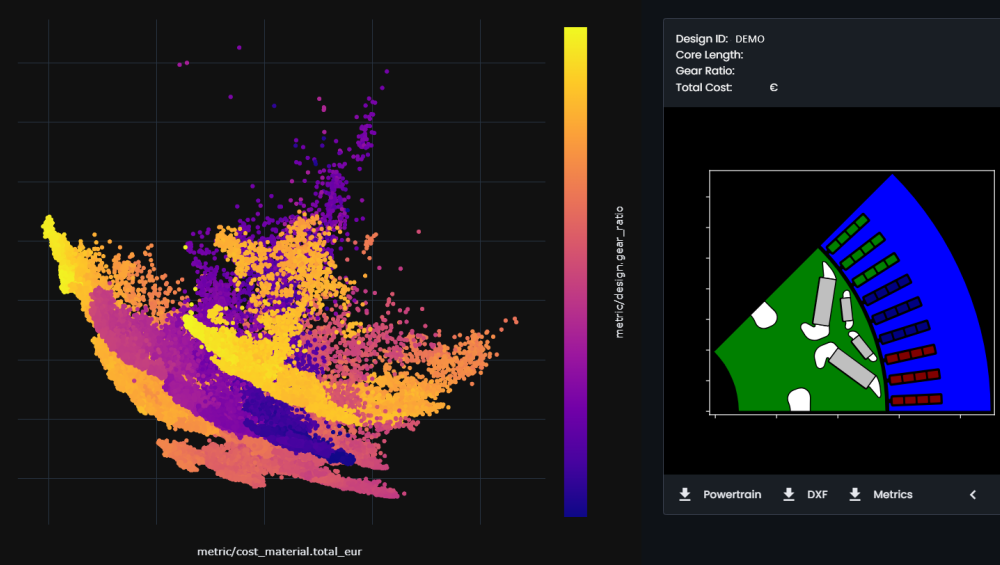
Conventional motor design can explore only a limited number of options because each one takes engineering time to simulate and test. Monumo's Engineering AI works from the customer's requirements and manufacturing constraints, evaluates millions of design variations, and sets out the trade-offs between cost, efficiency, performance and material use so engineers can choose with the full picture in front of them.
In recent projects, we have used Engineering AI to reduce the rare earth magnet content of an electric motor, cutting bill-of-materials cost by 20% or more with no loss of performance, on existing production lines and within a single product cycle. On another programme, a core powertrain component at a large auto manufacturer went from a 12-month design process to four weeks, using 8% less material.
Available now
Every motor designed with less magnet material is less exposed to export controls and price shocks. A 20% bill-of-materials saving, largely due to reduced permanent magnets, repeated across millions of units, not only reduces the volume of material new mines and refineries need to supply but also significantly improves the manufacturer's bottom-line margin.
According to the IEA's figures, new supply outside China will still fall well short of demand outside China in 2035 but a redesigned motor can reach production within a single product cycle of a few years. OEMs need to consider demand for rare earth materials as much as supply, as this market remains uncertain, with no supply solution looking like a short-term reality